Is the ice safe on a Rovaniemi ice fishing tour?
Stepping onto a frozen lake feels strange the first time, and the question comes up on almost every trip. On a guided tour, the people who choose the spot know the local ice well. This guide covers what the listings say, what general Finnish advice suggests and where the real risks lie.
Who picks the lake and the spot
On every trip on this site, the guide decides where you fish. They work the same waters through the winter, and they know which bays freeze early, where springs keep the ice thin and which tracks are safe for a heavy machine.
That local knowledge is the main thing you buy along with the gear. Guests never choose a spot on their own, and the group follows the guide from the shore to the holes.
How thick the ice gets around Rovaniemi
Wild About Lapland's listing gives a useful hint. On its trip the guide talks about local fishermen setting nets beneath ice up to a metre thick, which says a lot about a Lapland lake in the heart of winter.
General Finnish guidance commonly quoted is at least about 5 cm (2 inches) of clear, solid ice for one person on foot. Snowmobiles need much more than that, since a machine with two riders is far heavier.
In midwinter, lake ice around Rovaniemi is usually far thicker than those minimums. You get a feel for it yourself when the auger goes in, since cutting through takes steady work rather than a few turns.
Clear black ice is stronger than white, cloudy ice of the same thickness. Snow on top hides the difference, which is one reason only someone who knows the lake should choose the spot.
River currents and the edges of winter
Rovaniemi sits where the Kemijoki and Ounasjoki rivers meet. Moving water wears ice from below, so river ice can be thinner in places than the snow on top suggests.
Safartica's snowmobile route runs along frozen rivers on the way to its fishing spot, and that is the guide's call to make. It is exactly why you stay in the tracks and never wander off to explore a riverbank.
Early and late in the ice season the margins shrink. Ice that formed only weeks ago, or that softens under spring sun, is less predictable. Our guide to the best months for ice fishing explains how the season usually runs.
Natural ice and the small print
Arctic Circle Snowmobile Park's by-car ice fishing trip states plainly that the fishing takes place on natural ice and that moving around is at your own risk. Other operators work on the same kind of lakes.
Nobody grooms or tests a lake like an ice rink. The guides check conditions with their own experience, and the rest is up to guests following instructions.
If the ice worries you, ask before booking how the operator checks it and how far from shore the group fishes. A good guide answers that without fuss, and the answer tells you something about the company too.
A small group on a forest lake
Wild About Lapland walks a group of up to eight through old forest to a wide frozen lake, with no engines on the ice. You learn to drill your own hole, and the guide explains how locals fish under thick ice.
Around the holes
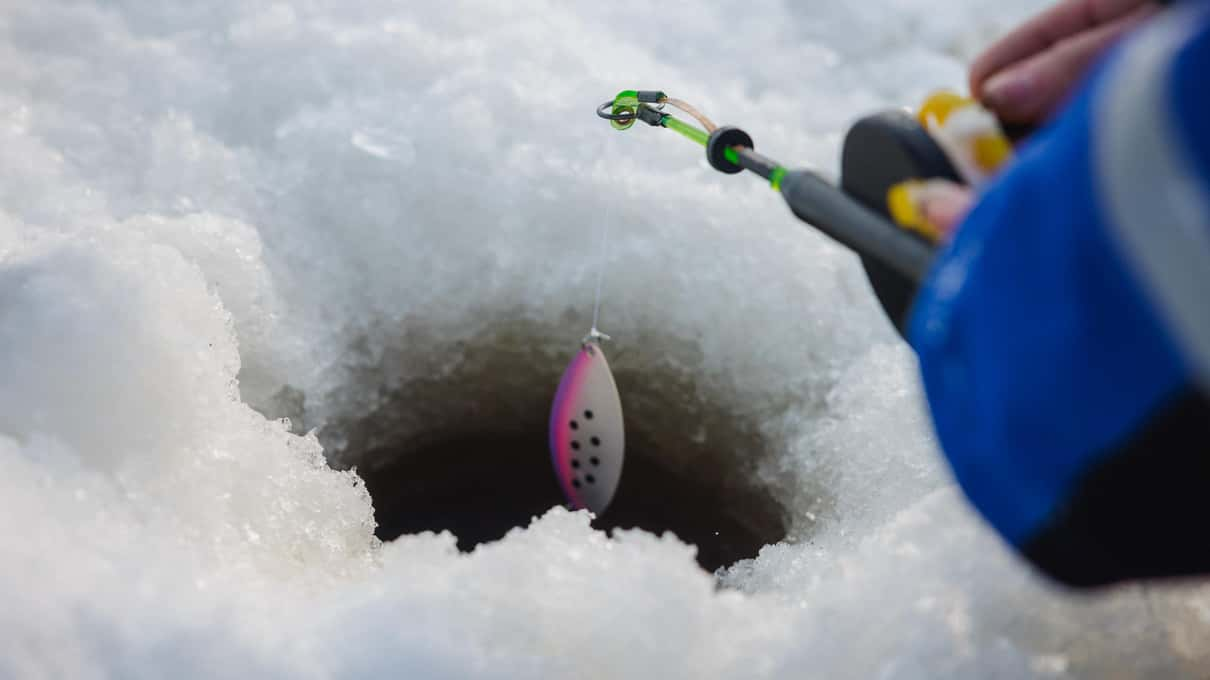
The biggest everyday hazard on a guided trip is not breaking through. More often people slip and twist an ankle, or step into a fresh hole hidden under loose snow.
Keep a clear picture of where each hole is, and walk around them rather than over. A finished hole is narrow, but a boot can still slip into it and wrench a knee.
Children need closer watching than adults. Keep small ones beside you near the holes and away from the auger blade, and read our guide to ice fishing with kids for age rules on each trip.
The hand auger has a sharp cutting edge. Follow the guide's instructions when it is your turn to drill, and lay it down flat when you are done. Our page on three hours on the ice walks through the drilling step by step.
Snowmobiles on frozen water
On Safartica's snowmobile day from ~$211 and the Arctic Circle combo from ~$181, you drive across frozen lakes in a line behind the guide. Stay in their tracks and keep the gap they ask for.
Drivers need a valid licence on both snowmobile days, and two people share each machine. Safartica's price includes snowmobile instructions before the group sets off, and that is a good moment to ask about crossing the ice.
Speed is the other factor. Ice can feel smooth but hide ridges and drifts, and a sudden swerve throws riders off. Both operators set liability charges for damage, which our price comparison spells out in euros.
If you would rather keep machines out of it, compare both styles in snowmobile or on foot. The walk-in trip puts only people on the ice.
Never on your own on a strange lake
Finland's everyman's rights (a version of the freedom to roam) broadly let people fish and walk on frozen lakes. That right does not tell you whether a particular patch of ice will hold.
Visitors should not head out alone onto a lake or river they do not know, least of all in early or late winter. A guided trip removes that guesswork, which is a big part of what the price covers.
Dress for a long stretch standing still, since cold is a bigger risk than the ice on most days. Our page on what to wear at −25 °C covers the layers, while the guide to short days and hard frost explains how the operators handle extreme cold.